Who you are buying from
A marketplace that buys real people's LinkedIn accounts and sells them outright — with the passport that proves whose they were.
Paying a stranger $200–$350 for something you cannot inspect first is a reasonable thing to be nervous about. So this page is about provenance: where each account comes from, what has been checked before it is listed, what physically changes hands at hand-over, and what happens if what arrives is not what was described. Every account here comes from a real, NFC-verified person who agreed to sell it, and that person's passport scan travels with the account when you buy it — so when LinkedIn asks the account to prove who it belongs to, you have the document to answer with.
Where you have landed
What this site is, and what it stopped being
500accs is a marketplace for LinkedIn account ownership. It buys established accounts from the people who registered them, and it sells accounts outright: one payment, the recovery email, the master password and the account holder's passport scan, transferred to you. Both directions run on this domain — the same desk that pays a seller is the one that prices the shelf.
In September 2026 the monthly rental business left this domain. You cannot rent or lease an account here any more, and there is no monthly fee on anything sold on this site except an optional LinkedIn subscription seat added to an account you already own. Renting by the month is now outzeach.com. What LinkedIn itself charges for Sales Navigator and Premium is explained on linkediz.com.
Some older articles in this blog, and several third-party roundups, still describe 500accs as a rental service. They are out of date. If a month or two of access is genuinely what you need, buying will not pay back and the rental site is the honest answer — the buy-versus-rent comparison linked at the foot of this page works out which.
How we source
Real humans, verified before they ever reach the shelf
Every profile in our inventory is supplied by a real person who has voluntarily agreed to sell their account to 500accs. We verify each applicant via NFC passport scan — the same biometric standard used by border control and Tier-1 banks. The scan stays in encrypted storage until a sale completes, then it is released to the buyer.
Sellers come to us from the United States, Western and Eastern Europe, Asia and developing markets. That is where accounts are found — where there is somebody to have a buying conversation with — and it is not a count of anything: we do not publish a number of countries against it, because it is not a number we could show you. What is held and ready to hand over is a narrower and far more specific claim, and it is published as one: counted, with the date it was counted on, on the stock page.
Neither of those is the market an account will run in. That is decided at handover, on any account here, by the profile's Location field and the dedicated ISP proxy it is given — so a seller in Jakarta and a buyer selling into Berlin are describing two different things, and both are ordinary here. Where an account was registered is the one thing nobody can change afterwards, which is why it is the thing sourcing is actually asked to go and find.
No bot generation. No stolen accounts. No AI-generated faces. If LinkedIn challenges the account after it is yours, you answer with the Transfer Dossier — the notarized passport scan is in it — and where the challenge asks for the person who registered the account, we route it to the holder, who agreed to that before the lot was listed. That routing is bounded and the bound is published: we keep the holder’s verification record for twelve months from the transfer, and the holder can withdraw before then — see the privacy notice. The scan in your own hands is not on that clock. What we do not do is promise a turnaround on LinkedIn’s own queue: section 9 of the terms says access after the 48-hour window is not guaranteed, and a sentence promising twenty-four hours over the top of it would be selling something the contract does not.
Read more on how NFC verification works.
Our infrastructure
Production-grade, not patched-together
- Dedicated ISP residential proxies — static IP per account, matched to the account's country of origin. No datacenter IPs, no shared pools, no rotation.
- Anti-detect browser profiles — pre-configured for AdsPower, GoLogin, Multilogin, Incogniton, and Octobrowser. WebGL, Canvas, AudioContext, WebRTC, and Client Hints fingerprints stay frozen across every session.
- Encrypted credential handover — login email, password, cookies, and recovery email transferred via end-to-end encrypted channels. No plaintext on the wire.
- Compatible with every major automation stack — Expandi, Waalaxy, Dripify, HeyReach, LinkedHelper, MeetAlfred, Lemlist, custom Puppeteer setups.
The proxy, the browser profile and the encrypted handover are bundled into every purchase — what a purchase includes.
Who buys here
Who ends up owning one of these accounts
Most buyers arrive with the same question — is this account really what the listing says it is — and come from five places: lead-generation agencies buying one identity per client, outbound teams whose quota lives on LinkedIn, recruiters sourcing at volume, founders keeping outreach off their personal profile, and SaaS teams who would rather book a one-time purchase than an open-ended monthly line.
What each of them typically buys:
- Lead-gen agencies — one identity per client, bought in batches, bulk pricing from five accounts
- SDR / AE teams — a Networked or Established tier with a Sales Navigator seat added at the counter
- Recruiting firms — aged senior profiles that read as credible to candidates
- Founders — keep outbound off your personal profile
- SaaS teams — a one-time purchase per person instead of an open-ended monthly line
All five start in the same place — the catalogue, then buying one outright. If the need is short-term, buying never pays back: the group rents by the month at outzeach instead.
Custody
Who holds what, and at which moment
- Government-ID verification on 100% of accounts (NFC passport scan, ICAO 9303 standard).
- 48-hour verification window — on every purchase, with its edges written down rather than waved away. It covers an account that arrives restricted or unusable, credentials or a proxy that do not work, and an account that materially differs from the listing summary you approved. It does not cover what follows your own use of it — send volume, automation settings, message content, changing the legal name or photograph, running the account outside the supplied proxy and browser profile, your outreach results, or a change LinkedIn makes to its own rules. Both halves are written out in sections 7.2 and 7.3 of the terms, and a built-to-order batch is arranged differently, in writing, before the build starts. How a transfer works →
- Encrypted ID storage — passport scans stored encrypted at rest and released only to the buyer, at handover.
- Consent on file with every account holder, covering the transfer and the ID recovery flow — and revocable by the holder, which is why holder-side support is bounded rather than permanent (see the privacy notice).
- Transparent pricing — a one-time price per tier, no setup fees, no proxy add-on and no recurring line of any kind.
- GDPR-aligned processing on EU-resident account holders, with documented data-processing agreements.
Already handed over
What the work looks like when it is finished
A marketplace that buys and sells accounts should be able to show some. These belong to the people who bought them, and they are here as they were photographed on the day — the badge, the country, the size of the network, the person. The employer is the one thing painted out, because the company never agreed to stand in an advertisement.
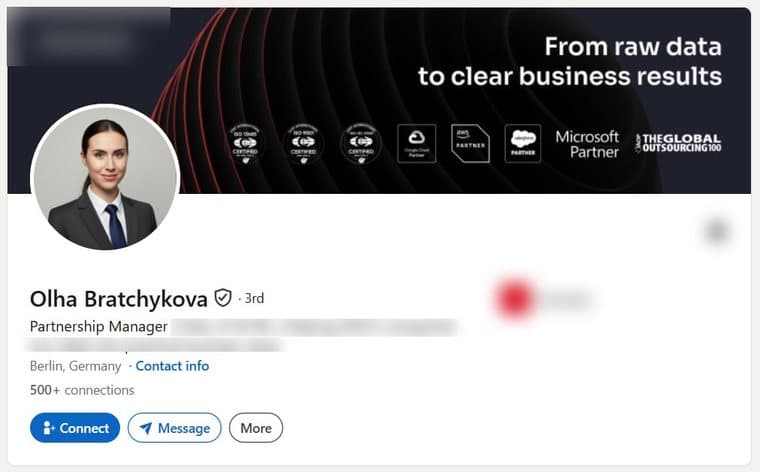
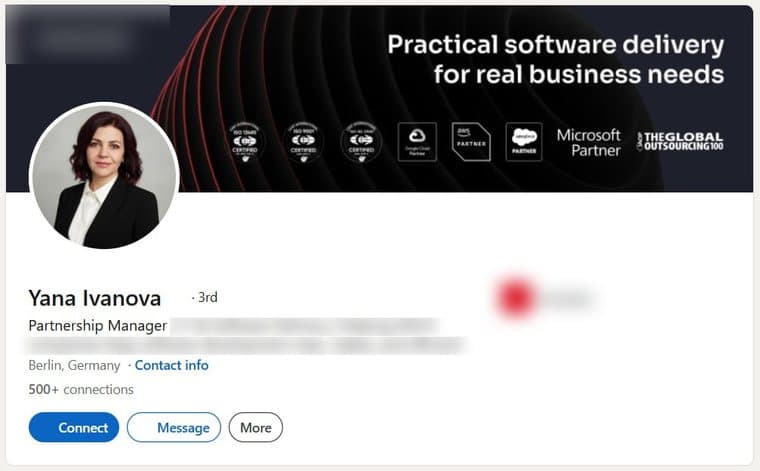
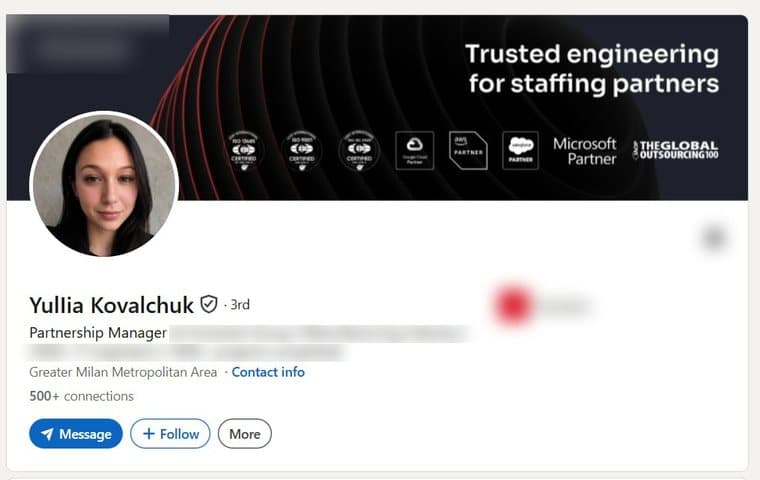
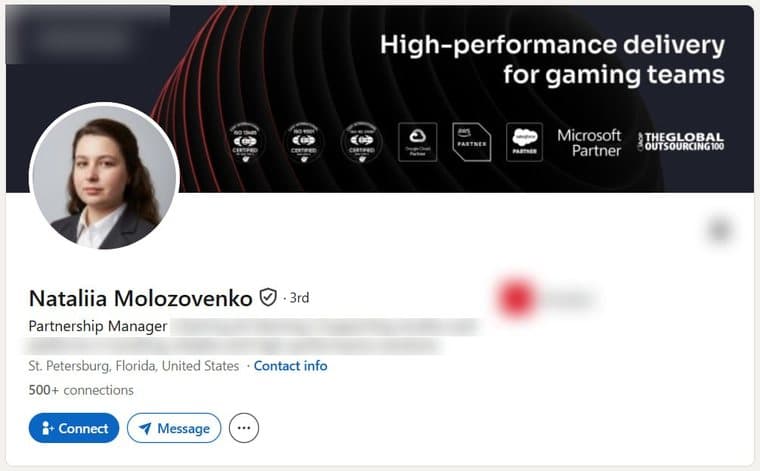
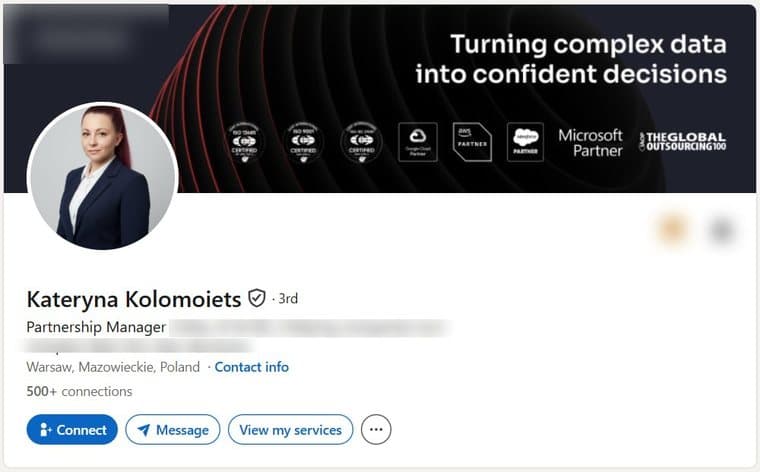
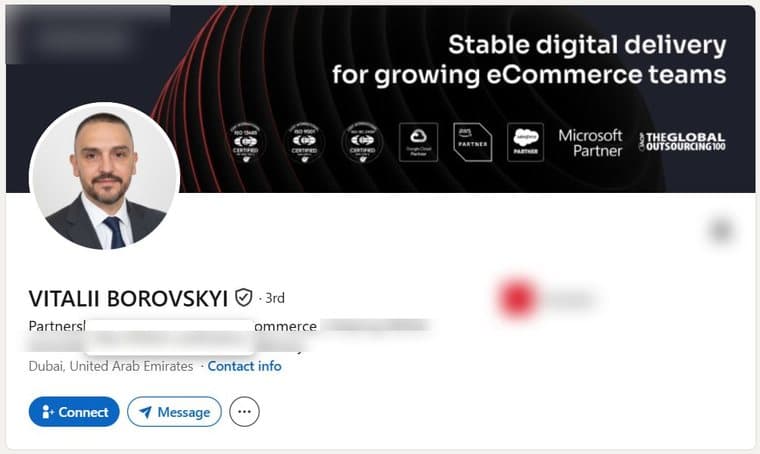
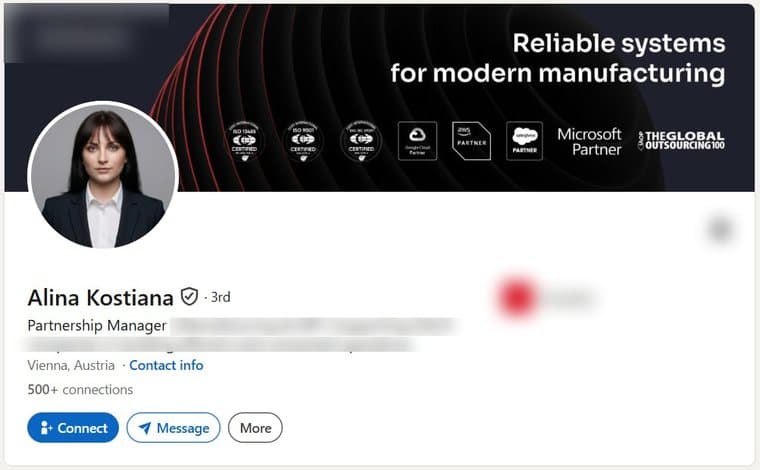
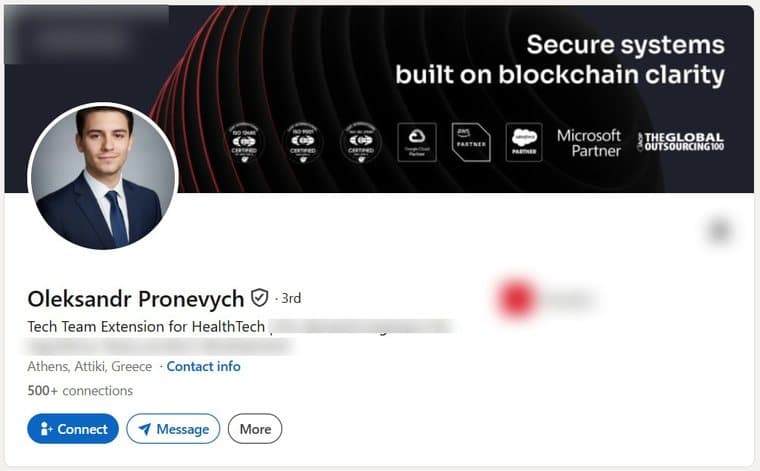
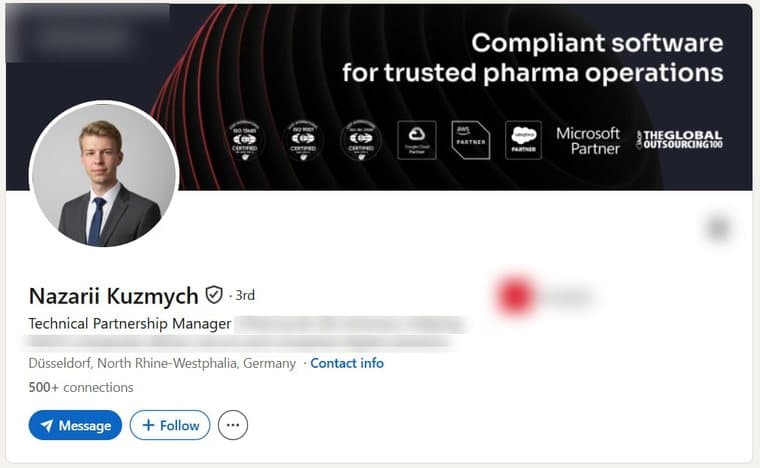
None of these is for sale. They are accounts that already belong to somebody, kept here as a record of work rather than as a catalogue — what can be bought today is on the shelf, where every listing carries a reference and a price. Held stock as of 19 September 2026 is described there too.
One thing is taken out of every screenshot: the employer — the company and the school in the side panel, the company where it is written into the headline, and its logo in the corner of the cover image. Everything else is as it stood, because an account you cannot see is an account you have no reason to believe in. The company comes out because it is the one party here that agreed to nothing.