Before you pay
How a LinkedIn account transfers to you when you buy it
You are about to send money to someone you have not met for an account you cannot inspect first. That is a reasonable thing to be careful about. This page is the whole process end to end — what we show you before payment, what arrives at handover, what you control afterwards, and exactly what the replacement window does and does not cover. The short version is one sentence: what changes hands here is not a login. It is an account whose registered holder signed the transfer before the account was ever listed and agreed to stay reachable afterwards, which is the one thing a resold password can never be.
Before any of it
The step that happens before the account is ever listed
An account reaches this shelf one way. The person who registered it — the person in the photograph, with the work history and the network — agrees to sell it, signs a record of the transfer, and agrees to stay reachable afterwards in case LinkedIn ever asks the account to prove who registered it. Nothing here is recovered, scraped, bought from a third hand or generated. If the holder will not sign, or withdraws consent while the account is still in stock, it is retired rather than listed.
That is a narrow-sounding sentence and it is the entire difference. Almost everything written about buying a LinkedIn account warns you that what you are really sold is a set of credentials: no control of the email they reset to, no document when the identity prompt arrives, and no counterparty once the money has moved. Every one of those warnings is accurate about most of this market. The answer to it is not a stronger promise from a seller, because a promise is exactly what the warning is about. The answer is that there is a real person, they agreed to this, and they have not gone anywhere.
The process
Five steps, usually inside one business day
1. Send a shortlist request
Tell us the market you are selling into, the account age, the connection tier and the broad industry you need — on Telegram, WhatsApp or email. Say also whether the account has to be registered in that market or only operate there, because those are different orders and only one of them is a sourcing problem. There is no form and no account to create. If what you describe is not in stock, we say so instead of substituting something else.
2. Review redacted profile summaries
We come back, usually the same day, with a shortlist. Each entry shows country, audited account age, connection tier, the verified owner’s industry and language, and the verification status. The full profile URL stays redacted until purchase — published inventory gets scraped, and scraped inventory gets flagged.
3. Confirm the tier and pay
You pick a profile, we confirm which price tier it falls in before any money moves, and you pay once — card, bank transfer, or USDT/USDC. There is no recurring charge afterwards and no proxy bill on top.
4. Receive the encrypted handover
Credentials and infrastructure arrive together through an encrypted channel: login email, master password, session cookies, control of the recovery email, the anti-detect browser profile, and the ISP residential proxy, provisioned in the market you named. The profile’s Location field is set to the same market before the account reaches you. The proxy and the browser profile are not accessories to the credentials. An account that signs in from a new country, on a machine it has never been opened from, on the day it changed hands is the pattern that gets accounts checked — so the environment the account has always run in is handed over with it, and the day of the sale is not also the day everything about the session changes.
5. Verify inside the 48-hour window
Log in, import the browser profile, check the history and the connection graph against what you were shown. If the account is restricted inside 48 hours because of our infrastructure, we replace it at no charge. After that the account runs on your usage patterns — and it is yours. The window is the part that expires. The part that does not is the person: the holder signed the transfer before the account was listed and agreed to stay reachable, so an identity challenge that arrives months after the window has closed still has somebody behind it who can answer it.
Paying
What happens when you pay, and what stands behind it
Everything below is already written into our terms of sale, and each step says which section it comes from. That is deliberate: a promise made on a sales page is worth what the page is worth, and a promise made in the document the sale is governed by is worth rather more. Read the sections — they are short, and they are the version that binds us.
1. The account and its price are fixed in writing first
You pick a profile from the shortlist and we confirm, in writing, which account it is and which tier it falls in — before any money moves. Nothing on this site is an offer capable of acceptance until that confirmation exists, and the contract of sale forms when you pay the confirmed price for that specific account. So the price you agree is the price you pay, and the account you agreed is the account you get.
2. One payment, and nothing added to it
Prices are in US dollars and exclude taxes where your own law imposes them. The purchase price is one-time: no setup fee, no proxy fee, no management fee, no renewal and no billing cycle. The dedicated ISP residential proxy and the anti-detect browser profile are inside the $200–$350 figure, not added to it.
3. Card, bank transfer or stablecoin
We accept card payment, bank transfer (US wire and SEPA) and stablecoin transfer in USDT or USDC. The stablecoin route exists for buyers in regions where card payments are restricted, not as a preference of ours — it is there so somebody in a restricted market is not pushed into an arrangement with no record of it.
4. Payment comes before handover — and that is what the window is for
Be clear-eyed about the order of events, because it is the part worth being careful about: you pay, and then the credentials, the proxy, the browser profile and the Transfer Dossier arrive through an encrypted channel. Nothing about that ordering is unusual for an account sale, and nothing about it is reassuring on its own. What answers it is the 48 hours that follow, which is the period in which we carry the risk that the account or its infrastructure fails on arrival, rather than you.
The 48 hours after handover
What the window covers, and what it does not
A window that covered everything would not be a commitment, it would be advertising. This one is narrow and specific: it covers the account arriving broken, and it covers the account not being what you approved. It does not cover what happens once you start using it. Both lists are reproduced from Terms §7 without editing, including the second one.
Covered — we replace or refund
- An account already restricted, checkpointed or unusable when you first log in
- Credentials that do not work, or a recovery email that was not in fact transferred
- A misconfigured proxy, or a fingerprint inconsistency in the browser profile we supplied
- An account whose age, connection tier, country or verification status materially differs from the summary you approved
Not covered — these are operating decisions
- Restrictions that follow your own use: send volume above LinkedIn’s limits, automation settings, message content, recipient complaints
- Restrictions that follow changes you make, including changing the legal name or the profile photograph
- Use of the account outside the supplied anti-detect profile or proxy, or concurrent sessions from several locations
- Outcomes of your outreach — acceptance rates, reply rates, meetings, revenue
- Changes LinkedIn makes to its own rate limits, verification policy or detection systems
If it goes wrong
What happens if the account does not open
Tell us inside the 48 hours, on any channel, with whatever evidence you have — a screenshot of the restriction or checkpoint, the time of first login, and the client or tooling you used. We acknowledge within one hour during business hours and within four hours overnight, and within 24 hours of that acknowledgement we tell you whether the claim is covered and what we are doing about it. Those are the response times in Terms §7.4, not a service level invented for this page.
If the account materially differs from the summary you approved — a different country, a materially lower age, a connection count in a lower tier than the one you paid for, a verification status that is not what we stated — the choice is yours, not ours: a replacement matching what you approved at no further charge, or the purchase price refunded in full against your return of the credentials. The same choice applies when an account covered by the window cannot be recovered and we cannot supply a comparable replacement. If we cannot deliver an account you have already paid for, or we cancel the order before handover, the money comes back in full. Terms §8 and §5.4 →
And the other half of that sentence, because a page that only prints the favourable half is not worth reading: when the 48 hours close, the sale is final. The account runs on your usage patterns, we no longer hold credentials for it, and we cannot recover it for you — the recovery email is in your hands precisely so that you do not need us. What outlasts the window is not a refund right. It is the Transfer Dossier and the holder who signed it, which is what an identity challenge months later actually asks for.
Before you send anything
Put the arrangement in the written confirmation
The confirmation that fixes the account and the tier before payment is the right place for anything else your side needs settled — a company invoice, the order of events you want, or a third-party escrow service if that is a condition of your purchase. Ask before you pay rather than after, and get the answer in writing. What binds us is the terms of sale and what we confirm to you for your order; anything agreed in a chat window and written down nowhere binds nobody, which is true of every seller in this market including this one.
The one thing the terms already settle is that nothing is added to the confirmed price afterwards: the purchase price is one-time, and there is no setup fee, no proxy fee and no management fee on top of it — the dedicated ISP proxy and the anti-detect browser profile are inside the figure rather than billed beside it. So a charge appearing after payment, under any name, is not part of this sale. If it is not in the written confirmation, ask what it is before you pay it. Terms §5.2 →
After handover
What you control once the account is yours
Ownership is not a label here — it is the specific list of things that move into your hands at delivery:
- A route back to the person who registered it — they consented to the transfer in writing and stay reachable through us for an identity check afterwards
- Recovery email — transferred to you, so every password reset lands in your inbox
- Master password — you set a new one at handover
- Session cookies and the pre-built anti-detect browser profile
- The dedicated ISP residential proxy, provisioned in the market you named and matching the location the profile shows
- The connection graph, endorsements and activity history, untouched
At handover
What is set to your market, and what is not
Three things on an account are configured when it is prepared for you. The Location field on the profile is set to the market you are selling into. The ISP residential proxy the account runs behind is provisioned in the same place. And the anti-detect browser profile the account is opened through is built to match that proxy, so the fingerprint LinkedIn reads and the address the session arrives from agree with each other and with the profile, instead of a matched IP turning up behind a machine the account has never been opened on. All of it is inside the price, none of it is an upsell, and the first two can say London on an account registered in Ohio.
Three others are not configured, because nothing can change them without lying about the account. Where it was registered is a fact in LinkedIn’s own records. The employers and schools in its history were written year by year by the person who owned it. The connection graph is a list of real people who live where that person lived. So a US-registered account set to London is an account operating in the UK market with an American network — it is not a British account, it is not described as one here, and you are told which of the two you are buying before you pay.
Whether the network staying American costs you anything depends entirely on who opens the profile. If your recipients are in the United States it is the best thing about the account: the mutual connections are people they might genuinely know, and the second-degree paths into their companies exist. If your recipients are in Berlin or Manchester, a careful one will notice that every mutual connection is in Chicago, and on senior, low-volume outreach that is the point at which paying for an account registered in the market is worth it. Name a registration country and we will tell you what exists in it →
The moment that matters
Who answers when LinkedIn asks the account to prove who it is
Sooner or later LinkedIn points its identity flow at an account: an upload prompt for a government ID matching the profile name, and sometimes a step that only the person who registered it can complete. This is the point at which almost every bought account dies, and it is worth being precise about why. It is not that the buyer did something wrong. It is that there was never anybody on the other end of the question.
On an account bought here there are two answers to it, and the second is the one nobody else on this query can offer. The first is the document: a real person passed an NFC passport read, the name on the profile is the name that was verified, and the scan is in your hands at handover, so you can complete the upload without asking us for anything. How NFC passport verification works →
The second is the person. That holder signed the transfer before the account was listed and agreed to stay reachable for exactly this, so a prompt that needs a response from the human the profile names gets one. You do not chase them and you are not given their details — the request comes to us and we take it to them, which is the arrangement they consented to and the one our privacy policy commits to. It is a different arrangement from the 48-hour window, which covers our infrastructure and closes on time; this one is with the holder and outlasts it.
It is also why we recommend leaving the name and photo alone. Change them and both answers stop working at once: the document no longer matches the profile it exists to defend, and neither does the person standing behind it.
The honest version
Buy or rent — a decision rule, not a pitch
Buying wins on a long horizon. A one-time price stops; a monthly one does not, and the crossover sits at roughly six months of continuous use. Buying also puts the recovery path in your hands, which matters if a locked account mid-campaign is expensive for you, and it gives finance a one-time asset purchase to book instead of a recurring vendor line.
Renting wins on a short horizon. If the campaign is a quarter, if you are still validating an ICP, or if you would rather someone else carry the recovery obligation, paying monthly is simply cheaper and there is no reason to buy. Renting is not sold on this site — the group runs monthly LinkedIn account rental at outzeach.
Already handed over
Accounts that went through this exact sequence
Every step above ends here: a profile that opens for its new owner from the environment it always opened from. These are handovers that are done, photographed as they stood. Only the employer is out of them, so everything you would check before paying is still on the card.
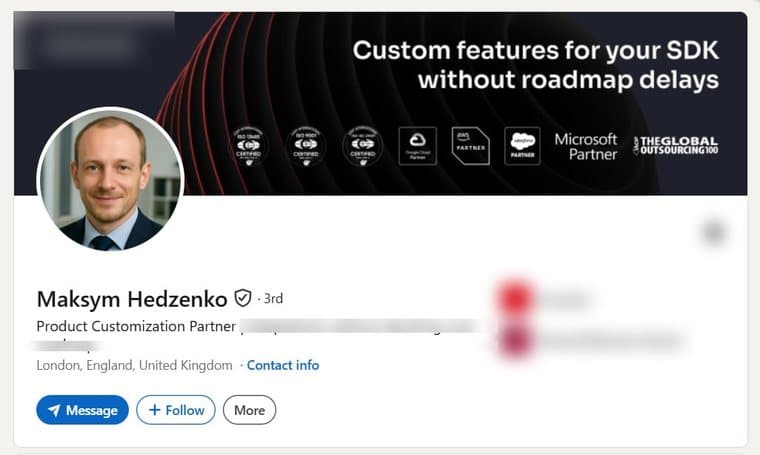
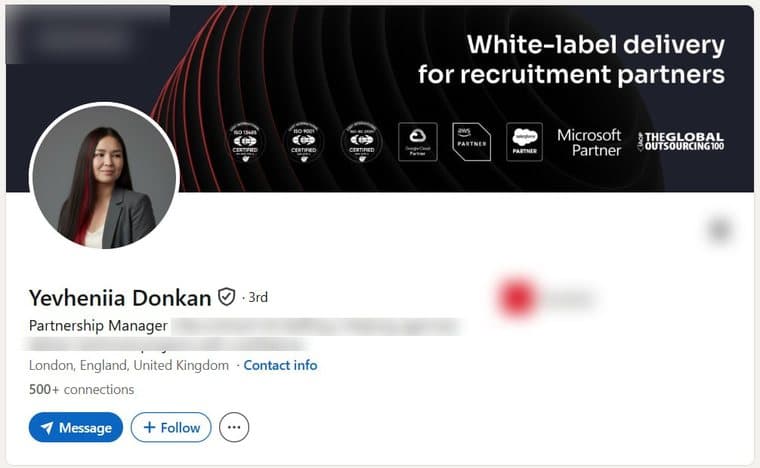
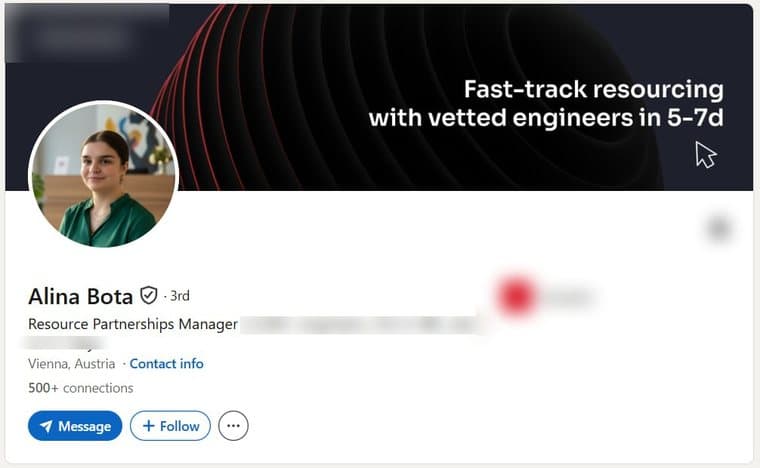
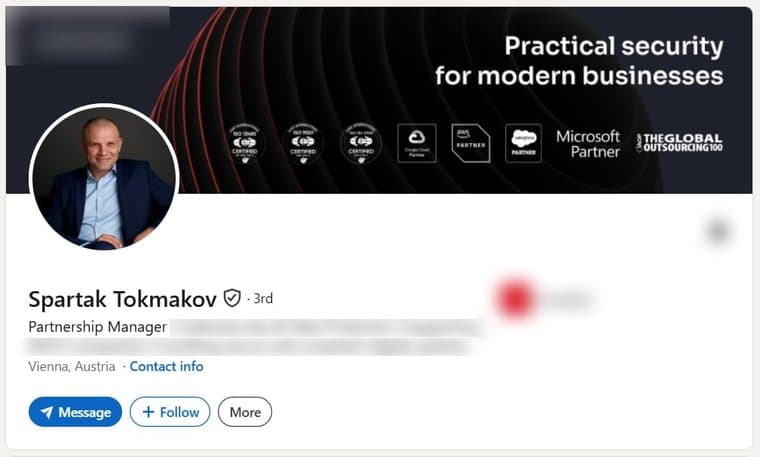
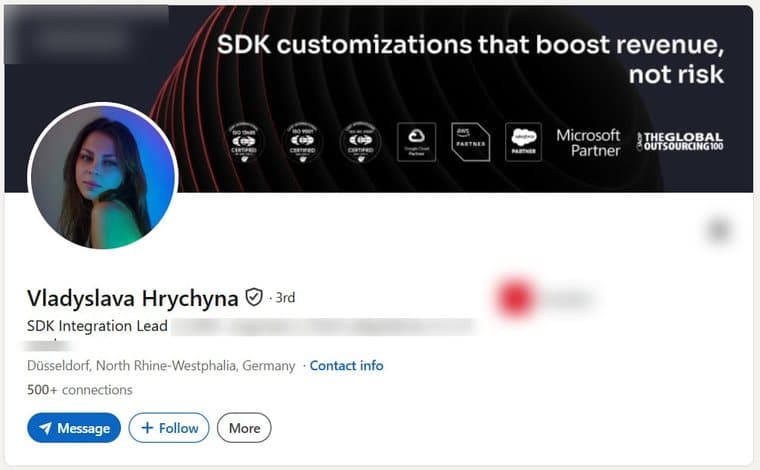
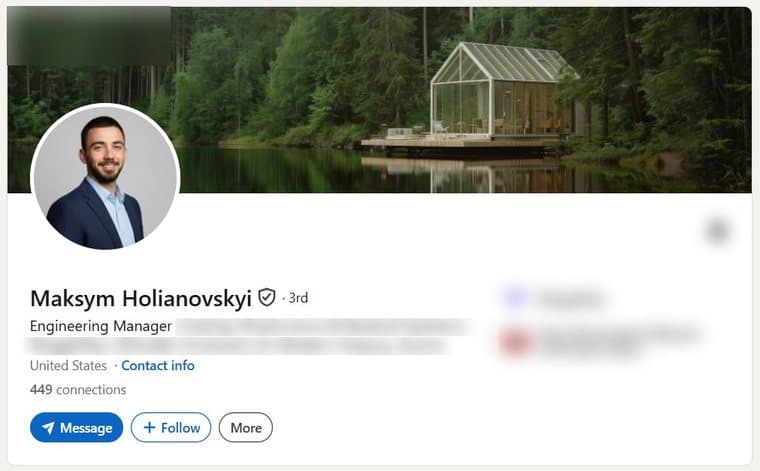
None of these is for sale. They are accounts that already belong to somebody, kept here as a record of work rather than as a catalogue — what can be bought today is on the shelf, where every listing carries a reference and a price. Held stock as of 19 September 2026 is described there too.
One thing is taken out of every screenshot: the employer — the company and the school in the side panel, the company where it is written into the headline, and its logo in the corner of the cover image. Everything else is as it stood, because an account you cannot see is an account you have no reason to believe in. The company comes out because it is the one party here that agreed to nothing.
Watch an account, don't take our word
What step two looks like in your inbox
Before any money moves, the account you asked about is recorded end to end and sent to you: the profile as it stands, the verification badge, the connection count, the history, the activity. These three are the format — press play, nothing loads until you do.
These three are not lots. What is for sale is on the shelf, where every listing carries a reference, an audited age and a price. Ask about one of those references and the same walkthrough is recorded of that account and sent to you — before you pay anything. The profile URL itself stays private until the sale completes, which is why it is out of frame here.
Questions people ask before paying
How do I know the account will not be reclaimed later?
The recovery email transfers to you at handover, which means the reset paths are in your control rather than ours. That is the test to apply to any seller, including this one: a seller who keeps the recovery address still owns the account, whatever the invoice says. We retain a copy of the original credentials only for the duration of the 48-hour replacement window, and only so a replacement can be issued if the infrastructure fails on first login. The original holder stays reachable for an identity check, which is a different thing from staying in control of the account — they hold no credential and no reset path once the handover is done, and the transfer they signed is the record of that.
Can I contact the account holder myself?
No, and that is deliberate on both sides. You are not given the holder’s contact details — what you receive about them is the Transfer Dossier, the notarized NFC passport scan and the signed transfer agreement, which is the limit our privacy policy sets and the limit they consented to. If LinkedIn asks the account for something only the registered person can supply, you bring it to us and we take it to them. It works this way because it is the version they agreed to: a holder who had to field messages from whoever bought their old profile would not have signed, and a seller who hands out that contact has a policy their sellers would not sign either.
What payment methods do you accept?
Card, bank transfer (US wire and SEPA), and USDT/USDC for clients in restricted regions. Prices are in US dollars and exclude taxes where your own law imposes them. The account and its tier are confirmed in writing before payment, so the price you agree is the price you pay, and the purchase price is one-time — there is no setup fee, no proxy fee and no management fee on top of it.
Do I pay before or after the account is handed over?
Before. You approve a specific account, we confirm it and its price in writing, you pay once, and the credentials, the proxy, the anti-detect profile and the Transfer Dossier arrive through an encrypted channel. That ordering is not reassuring on its own and we are not going to pretend otherwise — what answers it is the 48 hours that follow, in which we and not you carry the risk that the account or its infrastructure fails on arrival, and the terms of sale that say what we do when it does.
What happens if the account does not open when I log in?
Tell us inside the 48 hours with the evidence you have — a screenshot of the restriction, the time of first login, the tooling used. We acknowledge within one hour in business hours and four hours overnight, and within 24 hours of that we tell you whether it is covered and what we are doing about it. If the account is restricted on arrival, or the credentials or recovery email do not work, or the infrastructure is misconfigured, it is covered. If it materially differs from the summary you approved, the choice between a matching replacement and a full refund is yours. If we cannot deliver an account you have paid for, the money comes back in full.
What does the 48-hour window actually cover?
It covers our infrastructure: a proxy misconfiguration, a fingerprint inconsistency at first login, or an account that was restricted before you ever used it. It does not cover your send volume, your automation settings or a name and photo change you make after handover — those are operating decisions, and after 48 hours they are yours.
Can I change the name or photo after I buy?
You can, at your own risk. Doing so dissociates the profile from the verified passport, and if LinkedIn challenges the account afterwards the identity on file will not match the profile. We strongly recommend editing the headline, About section, Experience and current city instead — all sections LinkedIn treats as user-editable.
Can you change the account’s country?
Its location, yes. Its origins, no. The profile’s Location field and the ISP residential proxy are set to the market you are selling into, on any account, at no extra cost. The registration country, the work history and the connection graph stay exactly what they are — which is why an account registered in the United States and set to London is a US account operating in the UK market rather than a British one. The section above sets out when that distinction costs you something and when it is the thing you wanted.
Do you sell the same account twice?
No. An account leaves inventory the moment it is shortlisted for you and is marked sold at handover.
Can I buy several accounts at once?
Yes. From volume we negotiate, so the rate on a large order comes back in writing before anything is sourced. Above 25, hand-over is staged across several days so you are not importing dozens of anti-detect profiles in one sitting, and the whole order is matched on country, age band and connection tier.
Should I buy at all, or rent?
Buy when you expect to run the account beyond roughly six months, when you need the recovery path in your own hands, or when a recurring vendor line is a procurement problem. Rent when the horizon is short and you would rather someone else carry the recovery obligation — renting is not sold on this site, the group runs it at outzeach.
Ready to see what is in stock?
Send the market you are selling into, the age and the connection tier you need — and say whether the account has to be registered in that market or only operate there. We come back with a matched shortlist of redacted profile summaries and the exact tier price, usually the same business day.