Built to order · 3–6 months · owned outright

LinkedIn accounts built to order — nothing about them is second-hand

We register a new account under your brand, on a real person who passes an NFC passport read, style the profile the way you want it read, and grow the network at human pace over 3–6 months until it holds 500+ connections. Then ownership transfers to you: recovery email, master password, passport scan. $450 an account from ten, and the 3–6 months are not negotiable by anyone, including us.

  • Registered from scratch for your order — no previous owner, no history you did not commission
  • A real person behind it, verified by NFC passport read rather than a photo upload
  • Profile styled to your brand: headline, About, current role, photo brief — approved by you before growth starts
  • 500+ real connections, accumulated over 3–6 months at roughly the pace a person accumulates them
  • Ownership transfers outright at handover, with the ISP proxy and anti-detect profile in the box
  • $450 per account from 10, $400 from 50, $375 from 150 — one payment, no monthly fee, ever
See the price ladder

Built to your brief, not picked off a shelf · Recovery email and proxy in the box · Ownership transfers at handover

Why an account nobody has used before is a different object

Search "buy linkedin accounts" and half of what comes back is a warning: hijacked profiles, resold logins, accounts that go dark in the first week because the person who registered them changed their mind. Those warnings are largely fair, and they are about second-hand goods. This product removes the second-hand part rather than insuring against it, which is a different kind of answer — and it costs 3–6 months. The last card below is the one that says when you should be buying something else entirely.

There is no previous owner to come back

The commonest way a bought LinkedIn account dies is not a ban. It is the person who originally registered it deciding they want it back, or never really having agreed to part with it — a recovery email that was never moved, a phone number still on file, a password reset three weeks after the money cleared. On an account built to order there is one handover, it is planned from the registration onwards, and the person who registered it did so knowing that is what it was for.

No history you did not commission

A used account carries everything that happened before you: logins from countries you have never sold into, whatever automation the last owner ran, connections in industries that have nothing to do with yours, and a name that already has a shape in other people’s memories. None of that is visible on the listing and some of it never becomes visible until LinkedIn acts on it. A build starts at zero, on infrastructure that is yours from the first login.

The identity is real and the document is yours

The account is registered against a real person who has passed an NFC passport read — the chip, cryptographically signed by the issuing country, not a photograph of a page. That scan is handed to you at the end. When LinkedIn asks the profile to prove who it belongs to, and sooner or later it does, you answer with the document instead of opening a support ticket with a vendor.

The profile reads as your brand from its first connection

You are not rewriting a stranger’s profile into yours after the fact — a rebrand is an edit LinkedIn can see, on an account with no reason to have made it. Here the headline, the About text, the current position and the photo brief are agreed before the account has done anything at all, and every one of the 500 connections is made by a profile that already said what it says today.

Growth at human pace is the only kind that survives

500 connections spread across 3–6 months is between three and six a day, which is what a real person’s account does when they join a new company and reconnect with their industry. The same 500 in a fortnight is a different shape and LinkedIn is very good at shapes. This is the honest reason the wait exists: the 3–6 months are not queueing, they are the product.

When this is the wrong purchase

Three cases, and in all three you should spend the money elsewhere. If you need accounts working this quarter, a build cannot help you and the shelf can — real accounts with real histories, available now, from $195 on the published shelf, and the established listings on it start at $345, which is the band a reader of this page usually wants. If you want fewer than ten accounts, this is not sold below that and the shelf is again the answer. And if the accounts only have to exist for a campaign or a quarter, ownership is the wrong model altogether: rent them by the month at outzeach, which is where the group does that, and keep your capital.

What the 3–6 months actually buy

The wait is the single hardest thing about this product to sell and the single best reason to buy it. Here is what is on the other side of it.

  • An account with a past, on its first day with you

    It arrives already 3–6 months old, with a connection graph built one accepted invitation at a time and activity spread across the whole period. That is not something that can be assembled the week before delivery at any price, which is exactly why it is worth something.

  • A network built in your category

    The connections are grown against the industry, seniority and country you specified, so the 2nd-degree paths the account gives you point at people you actually sell to. A used account’s graph points wherever its old owner’s career went.

  • Infrastructure that was never shared

    Each account is registered and grown behind its own static residential ISP proxy in its own country, inside its own anti-detect browser profile. The account has never been logged into from anywhere else, by anyone else, on any other fingerprint. Both come with it, inside the price.

  • A document you can answer a challenge with

    The NFC passport scan transfers with the account. An identity challenge is a form to fill in rather than an event that ends your access.

  • An asset, not a subscription line

    Ownership transfers outright. The account keeps ageing on your side of the ledger, it can be handed to a successor or moved between entities, and the payment stops after it is made. The rest of this market rents these by the month; at twelve months a rental has cost more than the build and still belongs to the vendor.

  • A batch that matches

    Ten, fifty or a hundred and fifty accounts built to one brief arrive as a set: same standard, same infrastructure convention, same styling logic, handed over together. Buying that consistency off a shelf of second-hand accounts is not possible, because the shelf is whatever people were willing to sell.

If the accounts only need to exist for a campaign or a quarter, 3–6 months of build time and permanent ownership are both the wrong shape — the cheaper answer is to rent ready accounts by the month: rent LinkedIn accounts at outzeach

Verified LinkedIn profiles from real professionals across 12 countries, each with an NFC verification badge
Real professionals, verified profiles, listings published from 12 countries. Illustration — every listing on the shelf is audited individually.

What building an account to order involves, month by month

There is no compressed version of this and no premium tier that skips a step. It is worth reading the sequence before you commit $4,500, because the sequence is what you are paying for.

Before anything — the brief

You give us the brand the accounts should read as, the role and seniority they should hold, the country, the language, and the kind of people the network should be made of. That brief is what the whole batch is built against, and it is also where we tell you if part of it is not buildable.

  • Brand, role, seniority, country, language
  • Who the connections should be — industry and level
  • How many accounts, and when you need them working

Week one — registration on a verified person

A real person, NFC passport read on file, registers the account. It is registered from the country it will live in, behind the static residential ISP proxy it will keep, inside the anti-detect browser profile it will keep. Nothing about the account’s origin is borrowed from another account.

  • NFC chip read, not a photo of the passport page
  • Registered on its own ISP residential IP, in its own browser profile
  • One person, one account, one set of infrastructure

Weeks one to two — styling, and your sign-off

Headline, About section, current position, experience, education, banner and photo brief are built to your brief. You see the profile and approve it before any growth happens, because a profile restyled halfway through its network build is a profile that changed its story in front of the people it had already met.

The growth months — at the pace a person grows

Invitations go out in the account’s own category at a few a day, and the account behaves like an account: it accepts, it is accepted, it looks at profiles, it engages with what its industry posts. Nothing is bought, no connection-selling service is used, no list is imported. This is the part that cannot be shortened, and it runs until the account is past 500 connections.

  • A few accepted connections a day, not five hundred in a week
  • Connections drawn from the industry and country in the brief
  • Real posting and engagement across the whole period, not a burst before handover

Handover — the part that makes it yours

Login email, master password, session cookies, control of the recovery email, the NFC passport scan, the signed transfer record from the person who registered it, the ISP proxy and the anti-detect profile. From that moment every reset path on the account is yours and there is no key we kept.

What we will not do to make the wait shorter

We will not sell you an account that already existed and call it built for you. We will not import a contact list to manufacture the connection count, or buy connections from the services that sell them, or run the growth curve at several times the rate for a buyer in a hurry. Each of those would produce something deliverable in weeks, and each of them produces the account this page exists to not be.

What accounts built to order cost

Priced per account, with the price moving on the size of the order rather than on connection count — every account in every tier is built to the same specification and handed over past 500 connections. Ten is the minimum, so the smallest order here is $4,500. The ISP residential proxy and the anti-detect browser profile are inside the per-account price.

Built-to-order price per account, by the size of the order.
Order sizePrice per accountBest for
From 10 accounts$450A first batch for one team, on one brand
From 50 accounts$400An outbound team being staffed a quarter ahead
From 150 accounts$375An agency putting seats under its own clients

One payment per account, nothing recurring. The price is fixed in writing before the first registration, and it does not move if the build runs to the far end of the 3–6 months window rather than the near one. Orders large enough to be staged are handed over in batches as each set passes 500 connections, rather than all at the end.

How buying works →

The terms, stated before you ask

Nothing here is a performance claim. It is the shape of the order: what is fixed, what it costs, and what arrives at the end.

Build time before handover — not compressible
3–6 months
Connections on the account at handover
500+
Minimum order, nothing sold below it
10
Smallest possible order, at the 10-account price
$4,500
NFC-read before the account is registered
Passport
You, from the day it is handed over
1 owner

The orders this makes sense for

Composite use cases drawn from buyer cohorts where the wait was the reason the order worked rather than the reason it did not. No named customers, no invented numbers — these describe decisions, not results.

“We stopped treating accounts as a purchase and started treating them as headcount lead time. The hiring plan said six SDRs starting in Q3, so the accounts were ordered in Q1. You cannot order these in Q3 and have them in Q3 — that is the whole thing you have to get right.”
VP SalesB2B SaaS · outbound team scaled a quarter ahead
“What we could not keep buying was inconsistency. Ten accounts off a shelf are ten different people with ten different histories, and onboarding them into one campaign meant ten different judgement calls. One brief, one batch, one standard was worth more to us than having them sooner.”
Agency PartnerLead-gen agency · seats supplied under its own clients
“Our compliance position is that we do not operate a profile whose earlier life we cannot account for. That rules out every used account regardless of how well documented it is. A profile registered for us, on a person we have the passport of, is the only version of this we were ever going to be allowed to run.”
Director of ComplianceRegulated financial services · small permanent fleet

Composite use cases drawn from agency and in-house customers. Names and identifying details omitted to protect customer confidentiality.

Already handed over

Built, grown, and handed over

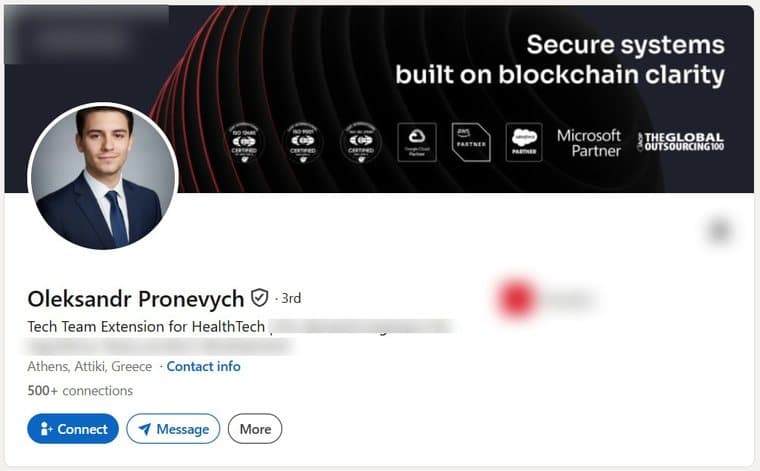
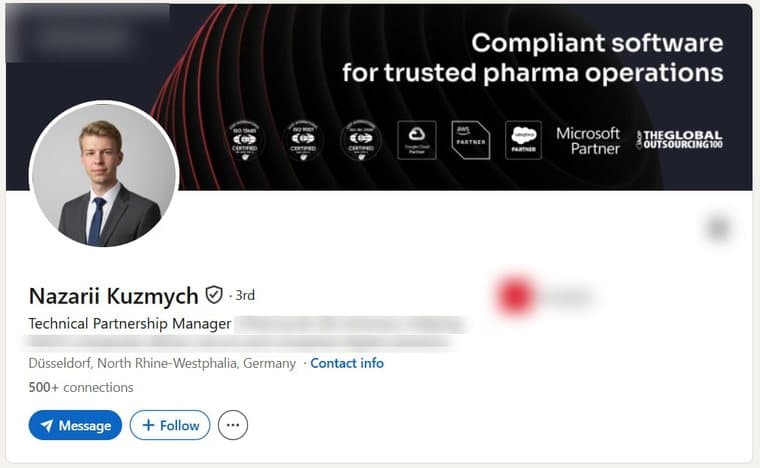
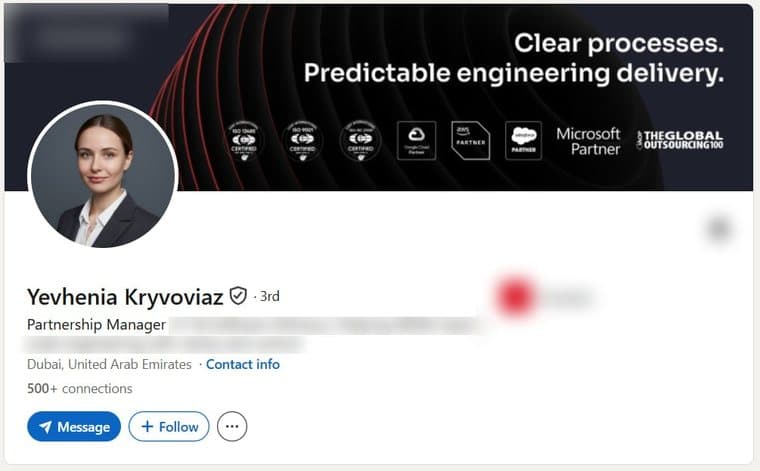
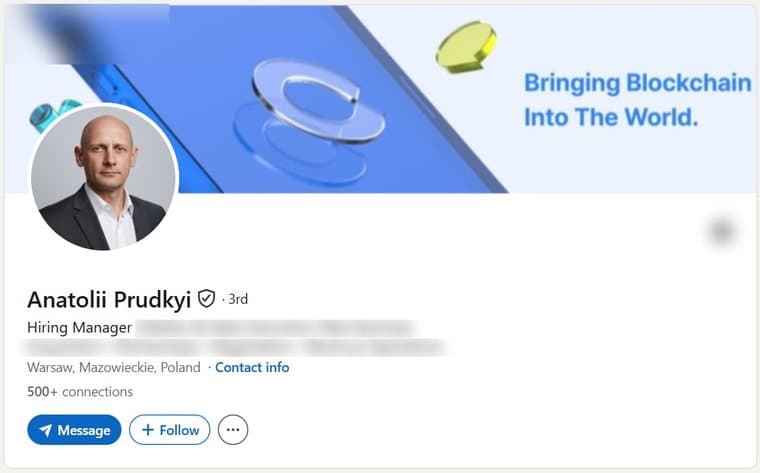
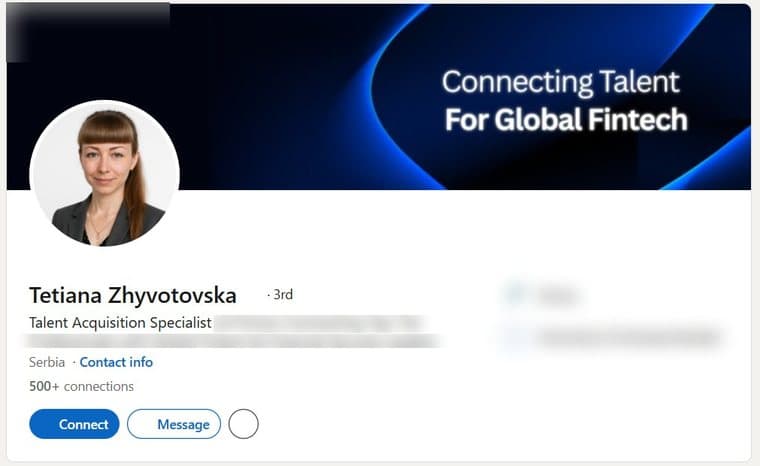
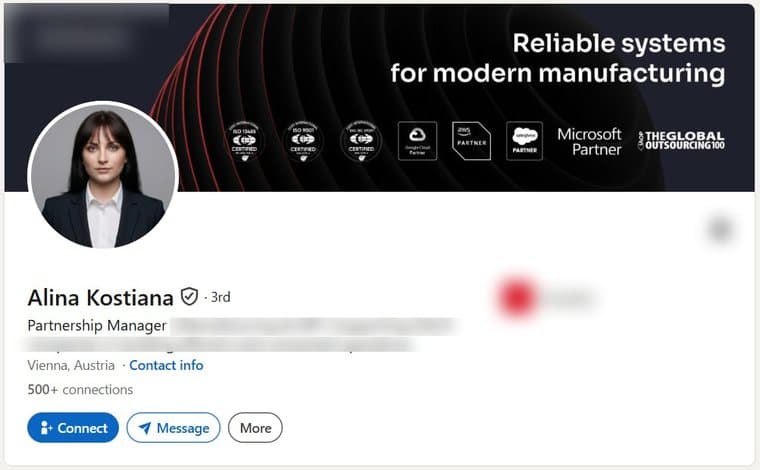
An account built to order is a real, verified profile by the time it reaches you — registered, then grown for three to six months before the transfer. These are finished ones, photographed as they stood. The brand each was styled to belongs to the buyer, so that is painted out; the rest of the card is as it was.

A LinkedIn account transferred to a buyer, photographed as it stood, with the employer's name and logo removed. The photograph, name, verification badge, role, country and connection count are as they were.

None of these is for sale. They are accounts that already belong to somebody, kept here as a record of work rather than as a catalogue — what can be bought today is on the shelf, where every listing carries a reference and a price. Held stock as of 19 September 2026 is described there too.

One thing is taken out of every screenshot: the employer — the company and the school in the side panel, the company where it is written into the headline, and its logo in the corner of the cover image. Everything else is as it stood, because an account you cannot see is an account you have no reason to believe in. The company comes out because it is the one party here that agreed to nothing.

Frequently asked questions

How much does a LinkedIn account built to order cost?

It is priced per account and the price moves with the size of the order: $450 each from 10 accounts, $400 each from 50, and $375 each from 150. Ten is the minimum, so the smallest order that exists here is $4,500. That is one payment for an asset you keep — there is no monthly fee on any of these, and the ISP residential proxy and anti-detect browser profile are inside the per-account price rather than billed on top.

Why does it take 3–6 months?

Because a connection graph is the one part of a LinkedIn account that cannot be manufactured, and the growth curve itself is a signal. 500 connections across 3–6 months is between three and six a day, which is what a real person’s account looks like when they join a company and reconnect with their industry. The same 500 inside a fortnight is a shape LinkedIn reads instantly, and an account carrying that shape is a restriction waiting for a trigger. The wait is not us being slow. It is the thing you are buying; everything else on the order — the passport, the styling, the proxy — can be done in a week.

Can I pay more to have them faster?

No, and there is nothing to charge for. The constraint is calendar time on each individual account, not our capacity, so extra money buys nothing that money can buy. Anybody who offers you an account with 3–6 months of growth on it next week is selling you something else: an account that already existed and belonged to somebody else, which is the second-hand product this page is the alternative to. That may well be the right purchase for you — it is sold on this site, off the aged shelf — but it is not this one, and it should not be priced or described as if it were.

Who is the person the account is registered to, and what stops them coming back for it?

A real person who has passed an NFC passport read — the chip inside the document, cryptographically signed by the issuing country. They register the account knowing it is being built for a buyer, and the transfer is signed rather than assumed. At handover you take the login, the master password, the session cookies and control of the recovery email, so every reset path runs through you; you also hold their passport scan and the signed record of the transfer. The failure mode people are right to fear on used accounts — the original owner still holding a recovery route — is closed here by the order of operations rather than by a promise.

What does "under our brand" actually mean — can I put my company name on it?

Yes, in every field LinkedIn treats as the user’s to write: headline, About, current position and company, experience, banner, and the brief the profile photo is shot to. What stays aligned is the person’s legal name, because that is what the passport says and the passport is what clears an identity challenge. So what you get is your brand on a real person’s profile — which is exactly what every employee’s LinkedIn profile is.

How is this different from requesting an account you already have?

They are opposite operations. A request searches: you name the age, connection count and country, and it is checked against stock held but not published, so a match is hours or days away and the order can be a single account. A build creates: there is no account until we register one for you, the order is ten accounts or more, and the first handover is 3–6 months out. Use the request form when you want an account that exists. Use this when you want an account that has never been anybody else’s.

Is this the same as renting a warmed account by the month?

No, and the difference is ownership, not quality. On a monthly rental the account stays legally tied to the person who registered it, the vendor keeps the recovery path and answers the ID challenges, and access ends when you stop paying. Most of the market that builds accounts for clients rents them out this way. Here the account is transferred to you outright and there is nothing to renew. If your horizon is a quarter, renting is genuinely the cheaper answer and the group runs it at outzeach — the link is above the tier table.

Who should not order accounts built to order?

Three groups, and it is cheaper for everyone if they read this now. Anyone who needs accounts working this quarter: no amount of money moves the calendar, and the aged shelf has real accounts available today. Anyone who wants fewer than ten: this is not sold below ten, and one aged account off the shelf will serve you better than an order you cannot place. And anyone whose need ends with a campaign: renting at outzeach costs less over that horizon and you are not tying capital up in an asset you will stop using. We would rather point all three elsewhere than take an order that was never going to work.

What exactly is handed over at the end?

The login email and master password, the session cookies, control of the recovery email, the NFC passport scan of the person the account is registered to, a signed record of the transfer, the dedicated static residential ISP proxy the account was grown on, and the anti-detect browser profile with its fingerprints already matched to that proxy. Nothing is reconfigured for the handover — you receive the setup the account has been living in since week one, which is why the first login from your side is not a change of environment.

Do you guarantee 500 connections?

500+ is the specification the build runs to, and an account below it is not finished, so it is not handed over. That is part of why the window is 3–6 months rather than a fixed date — accounts do not all accumulate at the same rate, and the honest version of a connection target is "when it gets there" rather than "on the 14th". If an account in your batch is clearly going to lag the rest, you are told during the build, not on delivery day.

What happens if LinkedIn restricts one of them after handover?

The 48-hour window that covers every purchase on this site covers these too: if an account is restricted within two days of delivery for something traceable to the build or the infrastructure it was handed over on, it is on us. But be clear about what a replacement means on a built account — it cannot be pulled off a shelf, because there is no shelf. So what happens to one account in ten is agreed in writing before the build starts, and it is usually either a replacement from the same batch or that account’s price refunded. Ask for that in writing anywhere you buy this product. Here it is in the order by default.

Can I watch the build, or log in during it?

You see and approve the styled profile before growth starts, and you get progress on the batch as it runs. You do not get the credentials mid-build, and that is deliberate: an account being logged into from two different setups while it is establishing itself is one of the few reliable ways to break one of these. The account lives in one environment until it is yours, and then it lives in yours.

Can I change the name or photo after I take ownership?

You own it, so you can. The cost of doing it is that the profile stops matching the passport you were given, and that document is the thing that answers an identity challenge. Change the headline, the About text, the role and the company as often as you like — those are fields LinkedIn expects to move. Leave the legal name and the face where they are.

Is owning an account registered by somebody else allowed under LinkedIn’s terms?

LinkedIn’s User Agreement requires a profile to represent a real, identifiable person. These do: there is a real person behind every account, their identity was verified against an NFC passport read before the account existed, and the transfer to you is documented rather than informal. How the account is operated afterwards — send volume, automation, message rate — is yours to decide and yours to answer for.
Start a build, or find out it is the wrong purchase

Tell us the brand the accounts should read as, the role and country, and how many you need and by when. You get a straight answer on whether a build of 3–6 months is what your timeline can actually absorb, and a written price before anything is registered.

Not seeing the account you need?

What is published here is a sample. Name the registration age, the minimum connection count and the country, and it gets checked against stock that is not listed — and if it is not held, it becomes part of what sourcing goes out to buy.

Request an account

The other side of the counter

Already have an old LinkedIn account? We buy those.

Everything on the shelf was bought from the person who registered it, in the United States, Western and Eastern Europe, Asia and developing markets. If you have a profile you have stopped using, send the country and the connection count — you get a figure, or a clear no with the reason, inside two business days. No login and no password to find out. What you sign is a transfer rather than a password handover: you consent to the sale, and you stay reachable afterwards in case LinkedIn ever asks the account to prove who registered it.

Browse accountsSell yours